Can Tenants Switch Energy Supplier? What Every Renter Should Know
Can Tenants Switch Energy Supplier? What Every Renter Should Know
4 Feb 2026

Millions of renters are quietly leaking money on energy.
Not because switching is difficult, but because most people assume they can’t.
In reality, if your name is on the energy bill, you can usually choose your supplier. And staying on the wrong tariff can mean overpaying month after month without realising.
Understanding how switching works is one of the simplest ways to reduce household costs.
The One Rule That Decides Everything
Before going any further, check this:
If the energy bill is in your name, you’re in control.
If energy is included in your rent, the landlord controls the supplier instead.
That single detail answers the question for most tenants.
Yet many renters never check, and remain on expensive default tariffs simply because they assume they have no choice.
What Happens When You Move Into a Rental?
Every property already has an energy supplier. When you move in and open the account, you’re typically placed onto a standard variable tariff.
These tariffs aren’t designed to be competitive; they’re designed for convenience and generally benefit the supplier. Stay on one too long, and you could quietly leak hundreds each year.
The good news?
Once the account is in your name, you’re free to compare deals and switch. There’s no interruption to your energy supply, and the process is handled behind the scenes.
Do You Need Your Landlord’s Permission?
Usually not.
Most tenancy agreements don’t prevent switching. Some may ask you to inform the landlord, while others require the property to be returned to the original supplier when your tenancy ends.
That condition rarely stops you from benefiting from a cheaper tariff while you live there.
If you’re unsure, scan your tenancy agreement for energy clauses; it takes seconds and removes uncertainty.
Variable vs Fixed Tariffs - Why It Matters
Many renters don’t review their tariff because they don’t fully understand the difference.
Variable tariffs move when the energy price cap changes, meaning prices can rise or fall several times a year.
Fixed tariffs lock your rate for a set period, protecting you from short-term price swings.
Over the past few years, price volatility has caught many households off guard, which is why more renters are paying attention to what tariff they’re on.
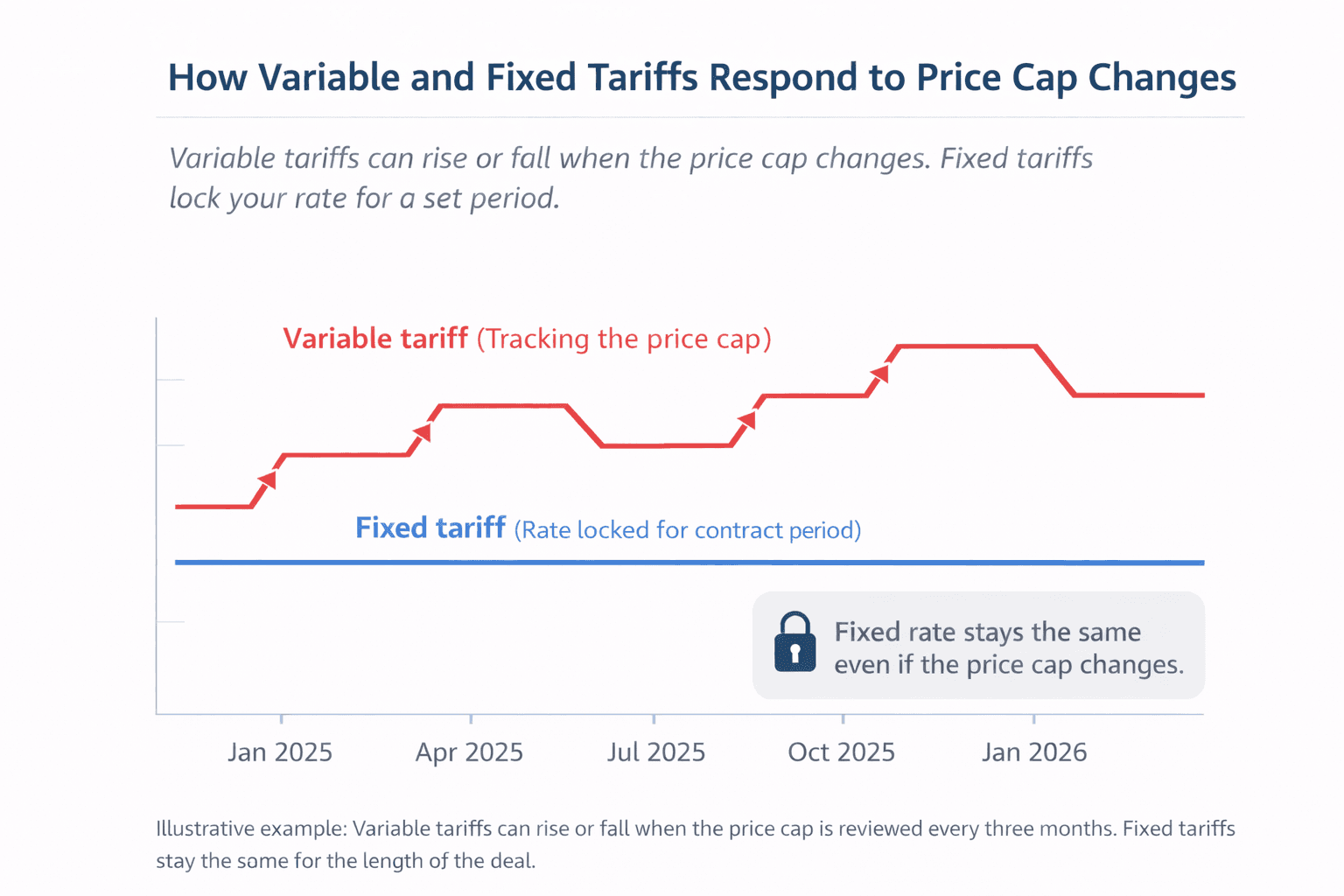
Illustrative example: Variable tariffs can fluctuate over time, while fixed tariffs remain stable for the duration of the contract.
Exit Fees: A Common Fear That Stops People Switching
One of the biggest psychological blockers is the fear of exit fees.
But many tenants start on variable tariffs, and these typically do not charge a fee to leave.
If you later choose a fixed deal, an exit fee may apply, but it is always shown before you agree to the contract.
In many cases, the savings from switching outweigh the cost.
The bigger risk is often doing nothing.
A 2-minute Check to See If You Can Switch
You can probably switch if:
✅ The energy bill is in your name
✅ Energy is not included in your rent
✅ No clauses in your tenancy agreement preventing you
Simple, but surprisingly overlooked.
Students, House Shares, and HMOs
The same principle applies in shared accommodation.
If the household manages the energy account, the household usually chooses the supplier.
Where landlords retain control, common in some HMOs, switching isn’t the tenant’s decision.
If you’re starting a new tenancy, switching early often delivers the biggest savings before months pass on a higher default tariff.
Why So Many Renters Overpay
Energy is one of the largest recurring household expenses, yet it’s reviewed far less often than phone contracts or streaming subscriptions.
Default tariffs create a quiet loyalty penalty.
Not dramatic enough to notice monthly.
Large enough to matter over a year.
A short check today can prevent unnecessary spending for months to come.
The Takeaway
If you pay the energy bill, you’re usually free to switch.
Many tenants don’t, and continue leaking money by default.
Checking takes minutes.
The impact can last all year.
See what deals are available in your area and find out whether switching could lower your monthly costs.
Millions of renters are quietly leaking money on energy.
Not because switching is difficult, but because most people assume they can’t.
In reality, if your name is on the energy bill, you can usually choose your supplier. And staying on the wrong tariff can mean overpaying month after month without realising.
Understanding how switching works is one of the simplest ways to reduce household costs.
The One Rule That Decides Everything
Before going any further, check this:
If the energy bill is in your name, you’re in control.
If energy is included in your rent, the landlord controls the supplier instead.
That single detail answers the question for most tenants.
Yet many renters never check, and remain on expensive default tariffs simply because they assume they have no choice.
What Happens When You Move Into a Rental?
Every property already has an energy supplier. When you move in and open the account, you’re typically placed onto a standard variable tariff.
These tariffs aren’t designed to be competitive; they’re designed for convenience and generally benefit the supplier. Stay on one too long, and you could quietly leak hundreds each year.
The good news?
Once the account is in your name, you’re free to compare deals and switch. There’s no interruption to your energy supply, and the process is handled behind the scenes.
Do You Need Your Landlord’s Permission?
Usually not.
Most tenancy agreements don’t prevent switching. Some may ask you to inform the landlord, while others require the property to be returned to the original supplier when your tenancy ends.
That condition rarely stops you from benefiting from a cheaper tariff while you live there.
If you’re unsure, scan your tenancy agreement for energy clauses; it takes seconds and removes uncertainty.
Variable vs Fixed Tariffs - Why It Matters
Many renters don’t review their tariff because they don’t fully understand the difference.
Variable tariffs move when the energy price cap changes, meaning prices can rise or fall several times a year.
Fixed tariffs lock your rate for a set period, protecting you from short-term price swings.
Over the past few years, price volatility has caught many households off guard, which is why more renters are paying attention to what tariff they’re on.
Illustrative example: Variable tariffs can fluctuate over time, while fixed tariffs remain stable for the duration of the contract.
Exit Fees: A Common Fear That Stops People Switching
One of the biggest psychological blockers is the fear of exit fees.
But many tenants start on variable tariffs, and these typically do not charge a fee to leave.
If you later choose a fixed deal, an exit fee may apply, but it is always shown before you agree to the contract.
In many cases, the savings from switching outweigh the cost.
The bigger risk is often doing nothing.
A 2-minute Check to See If You Can Switch
You can probably switch if:
✅ The energy bill is in your name
✅ Energy is not included in your rent
✅ No clauses in your tenancy agreement preventing you
Simple, but surprisingly overlooked.
Students, House Shares, and HMOs
The same principle applies in shared accommodation.
If the household manages the energy account, the household usually chooses the supplier.
Where landlords retain control, common in some HMOs, switching isn’t the tenant’s decision.
If you’re starting a new tenancy, switching early often delivers the biggest savings before months pass on a higher default tariff.
Why So Many Renters Overpay
Energy is one of the largest recurring household expenses, yet it’s reviewed far less often than phone contracts or streaming subscriptions.
Default tariffs create a quiet loyalty penalty.
Not dramatic enough to notice monthly.
Large enough to matter over a year.
A short check today can prevent unnecessary spending for months to come.
The Takeaway
If you pay the energy bill, you’re usually free to switch.
Many tenants don’t, and continue leaking money by default.
Checking takes minutes.
The impact can last all year.
See what deals are available in your area and find out whether switching could lower your monthly costs.
Find the best deal
We will confirm we have received your question or complaint and come back to you within 24 hours with an answer.
SOLVA SAVINGS LIMITED is a registered UK limited company number 16308784.
We will confirm we have received your question or complaint and come back to you within 24 hours with an answer.
SOLVA SAVINGS LIMITED is a registered UK limited company number 16308784.
We will confirm we have received your question or complaint and come back to you within 24 hours with an answer.
SOLVA SAVINGS LIMITED is a registered UK limited company number 16308784.
We will confirm we have received your question or complaint and come back to you within 24 hours with an answer.
SOLVA SAVINGS LIMITED is a registered UK limited company number 16308784.